

ADDRESS BY THE HON’BLE PRESIDENT OF INDIA, SMT DROUPADI MURMU AT THE BLACK SWAN SUMMIT, INDIA
Bhubaneshwar : 06.02.2026
Download : Speeches  (65.54 KB)
(65.54 KB)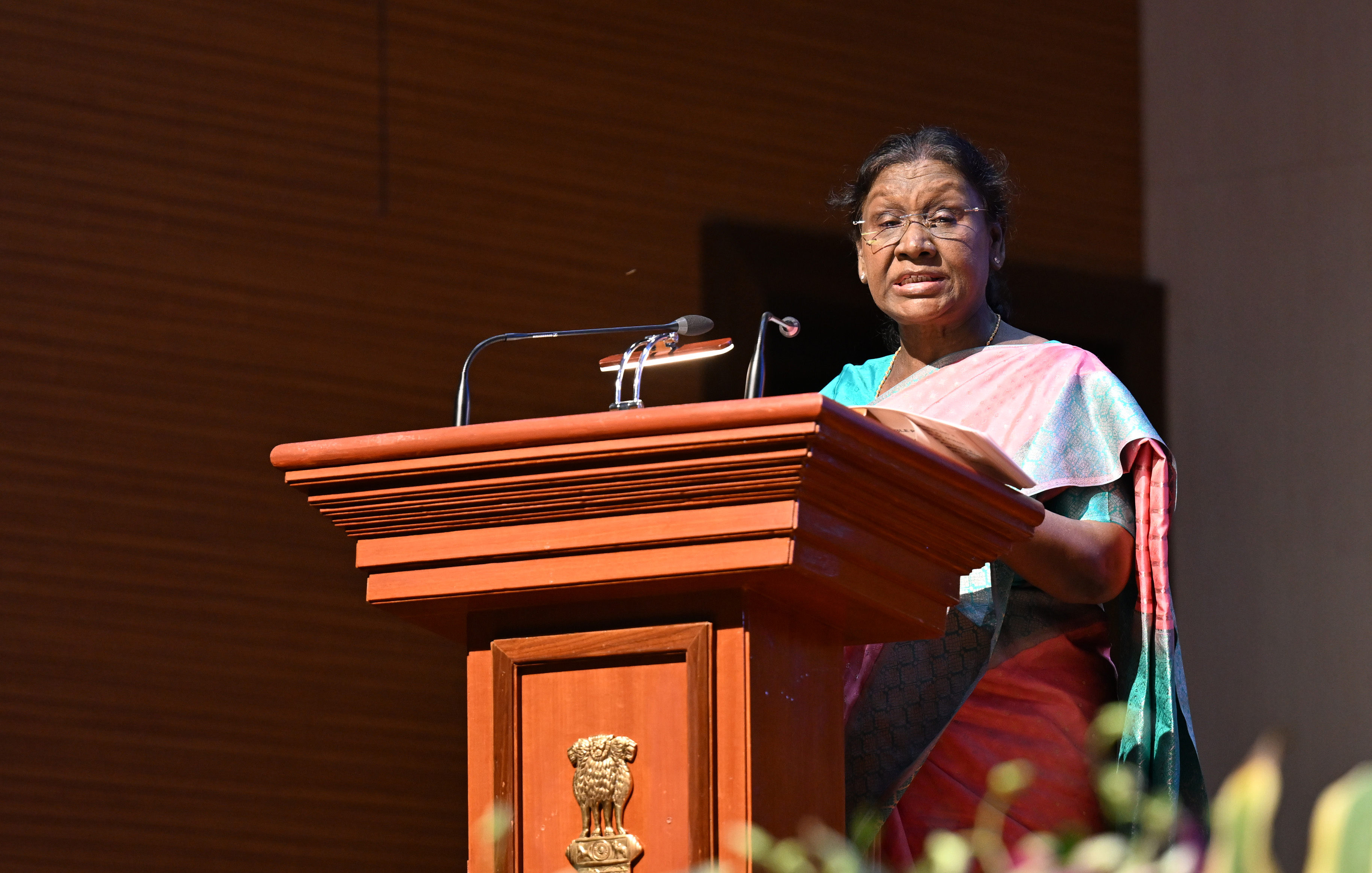
I am happy to be among you all at this important event related to the digital and financial transformation of Odisha. I commend the Odisha government and Global Finance and Technology Network for co- organising the Summit as part of the BharatNetra initiative. I am happy to know that Government of Odisha has launched BharatNetra, an initiative for building a future-ready workforce and innovation ecosystem in digital, financial and insurance technology sectors. The Black Swan Summit is a global platform to explore how technological innovation can build more resilience and bring inclusion. I am happy to know that it has brought together policymakers, technologists, financial institutions and investors on a single platform who have deliberated over two days on various topics ranging from AI and fintech innovation to sustainable finance, digital public infrastructure, and empowerment of Small and Medium Entreprises.
Today, we are living in a time when technology is evolving at an unprecedented pace. New innovations arrive so rapidly that our systems, skills, and business models often struggle to keep up. Automation, artificial intelligence, and machine learning are transforming every sphere of life—education, healthcare, jobs and business. At the same time, these rapid advancements can also bring serious challenges, including cybersecurity threats, deepfakes, misinformation, and an increasing dependence on technology. However, the rapid technological changes have a huge positive impact on innovation and growth. Through events such as this Summit, innovative methods can be explored to leverage technologies further enhancing capabilities through skilling, generate employment and accelerate the digital and financial transformation.
Ladies and Gentlemen,
In the past decade, India has witnessed an impactful revolution in the financial system. India is the fastest-growing major economy in the world. Our country is moving towards becoming the world’s third- largest economy in the near future. This has been possible due to enabling policies of the Government of India supported by innovations in digital and financial systems. In the past 11 years, more than 57 crore Jan Dhan accounts have been opened across the country which is a revolution in access, trust and wide participation of people. Today, with a simple smartphone and a basic bank account, a woman receives welfare benefits directly in her account, a farmer receives payments on time and a small kirana shop accepts digital payments from any customer. For them, “fintech” is not a technical term, it has become their lifeline.
India’s fintech story should be remembered not only as a tale of technology but also as that of gender justice. Women constitute an important segment that requires focused attention for the promotion of fintech. Fintech must view them not only as end users but as leaders, professionals, and entrepreneurs. Today, more than 56 per cent of Jan Dhan accounts are held by women. Therefore, for every new platform, product, or policy, it needs to be evaluated if it makes women active participants in the digital and financial ecosystem. An inclusive fintech ecosystem is one in which women are visible at every level, from village entrepreneurs and banking correspondents to engineers, founders, and board members. I am happy to know that separate session was held on Scaling Women’s Skills and Supporting Women-led SMEs in the Summit.
Even as there are achievements to be proud of, there are known and unknown challenges that need to be overcome. Fintech does not guarantee inclusion on its own. There continue to be citizens, especially in remote, tribal, and rural areas, who are not conversant with the digital tools. Skilling them is very important to make them participants in the development journey. Only then, fintech can become an engine of inclusion, employment generation and promotion of entrepreneurship. I urge our entrepreneurs and innovators to ensure that technology becomes a tool for social justice and inclusion.
Ladies and Gentlemen,
To cater to this growth story, there is a need for Fintech and Insurtech, as well as a skilled workforce. Fintech is about trust and human dignity. Digital finance is about giving citizens greater financial control over their lives. It is also about making the governance systems more responsive, transparent and humane. This citizen- centric thinking remains at the heart of India’s fintech journey. Artificial Intelligence is rapidly transforming our economy and society. The Government of India has launched IndiaAI Mission to promote AI research, innovation and ethical use. The upcoming India AI Impact Summit to be held in New Delhi this month, is expected to attract participation from about 100 countries. This event aims to ensure that AI is seen not merely as a technological advancement but as a strategic tool to enable inclusive growth and expand access to opportunities that have historically been out of reach for large segments of the population. I am confident that this event will play a huge role in leveraging global AI expertise and technology for benefit of people. I am happy to note that Odisha is also moving ahead in this direction and adopting Artificial Intelligence to improve governance, healthcare, agriculture, and public service delivery.
Ladies and Gentlemen,
Technology has a huge potential for making positive impact on all sectors of economy and all sections of society. However, at times it can be misused for financial frauds. Online financial frauds can cause people to lose their life savings and suffer high-level mental and social distress. It is pertinent to enhance awareness among people to be vigilant and alert to prevent such frauds. The Government of India has undertaken various measures to prevent and report such frauds including setting up of Indian Cyber Crime Coordination Centre, Citizen Financial Cyber Fraud Reporting and Management System and Cyber Fraud Mitigation Centre. Ensuring digital and financial literacy is essential to deter online financial fraud. It can be made part of school curricula so that the advantages and disadvantages of technology can be understood at a young age. I urge all stakeholders to make every effort to enhance digital and financial literacy among people.
Advancing skill development, establishing global capability centres, and enhancing innovation capacity is an investment in human capital. This is where the role of such a Summit becomes important. I am confident that it will enable the youth and entrepreneurs of the state to participate in the global digital economy. These efforts show that Odisha is ready not only to adopt financial technology for transformation but is also geared up to help shape the fintech ecosystem.
Ladies and Gentlemen,
We are marching ahead to build Viksit Bharat by 2047. All stakeholders should ensure that this journey remains anchored in the core values of inclusion, fairness, and dignity. I am confident that discussions and collaborations that emerge from this Summit will be of transformative effect not only for Odisha but also for India and the world. I extend my best wishes to you all for a bright future.
Thank you,
Jai Hind!
Jai Bharat!